

Sale products
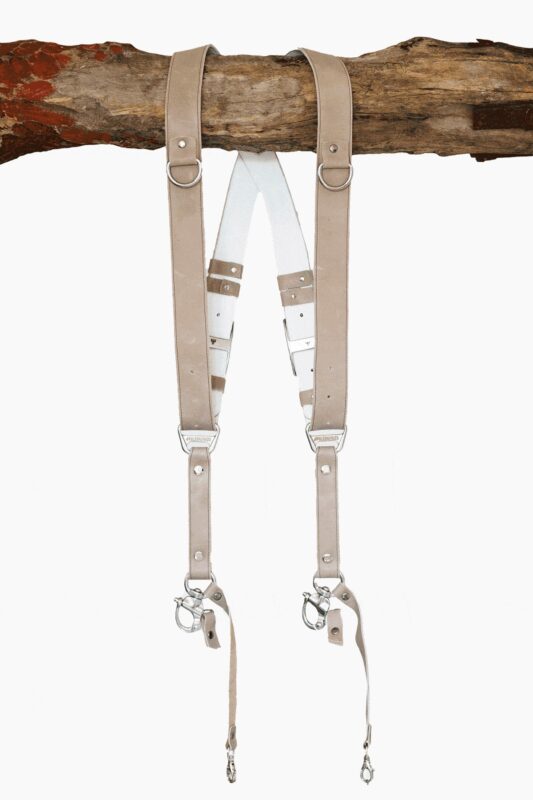
Sabbia Vintage Camera Harness
Original price was: 220.00 €.199.00 €Current price is: 199.00 €.
LEATHER STRAP & HARNESS
You have two cameras on your harness. The next question comes straight away: which lenses go on them, and which one goes on the right and which on the left?
In wedding photography forums the same thread comes back every season. We read what working photographers answer and watched how two photographers who have shot with two bodies for years set up their day. Here are the most common pairings, how to change them through the day and why the side matters more than you think.
“My long lens is always on the right and my wide on the left, so I know which one to grab without looking.”
Event photographer, YouTube
An event photographer puts it simply: when the scene jumps from wide to tight in a second, changing lenses on one body is never fast enough. In the dark it is worse, and the risk of dropping something is real.
The second reason is safety. A wedding photographer points out that if one camera fails, the other is already on you and ready. With two card slots in each body, every frame is saved twice.
The classic: a 24-70 f/2.8 on one body and a 70-200 f/2.8 on the other. It covers everything, from a group in a small room to a close-up from the back of the church. The cost is weight: one photographer calls the 70-200 the wrist breaker and takes it off after the ceremony.
The top answer among prime shooters. The 35 tells the scene, the 85 isolates people. Both are light and bright, which helps when the reception room is dark.
In a hotel room you are close to everything. One photographer pairs a 24 with a 50: with an 85, he says, he ended up on tiptoe in a corner. In big spaces others pick a 50 with a 105 or 135 instead.
A middle way: a 24-70 for everything and an 85 f/1.4 for portraits and low light. In the morning some swap the 85 for a 105 macro to shoot rings, shoes and details.
The event photographer quoted above keeps the long lens on the right and the wide lens on the left, always. Not because of a technical rule: it is muscle memory. When both cameras hang at your hips, your hand goes to the right one by itself.
The wedding photographer who shoots primes does the opposite: the wider lens on the left, the longer one on the right. Which side you choose does not matter. What matters is that it stays the same all day, even when you change lenses.
One more habit from the same video: switch the camera off as you let it drop to your side. Your body rubs against the dials and can change shutter speed or aperture. If your cameras knock together when you kneel, read how to stop it.
On Reddit the most upvoted rule is simple: if the lens is heavier than the body, attach the strap to the lens, at the 1/4″ socket on the tripod collar. That way the mount only carries the body, not the whole weight of the glass.
If you take the 70-200 off after the ceremony, you do not want to unscrew and screw back every time. Keep a screw fitted to each lens and each body: the clasp moves from one to the other in seconds. Step by step mounting is in the clasp tutorial.

Stainless Steel 1/4″ Camera Screw
19.00 €
In stock
Universal 1/4″ screw in stainless steel, made by hand: an attachment point for a body, a telephoto lens or a tripod plate. Keep one on each lens and swap without unscrewing.
Buy nowMore coloursThe advice from people who have done this for years is not to carry everything. Two bodies with two different ranges cover almost the whole day. For one extra lens, a waist pack or a small pouch is enough for a quick swap.
Some wedding and sports photographers prefer a third body ready to go, with a very wide or very long lens. If your harness has D-rings, you can attach it there.

Third Body Camera Harness Extender – Dark Brown
29.00 €
In stock
A pair of 30 cm leather extenders, clasps included, for the left and right side: they attach a third camera to the D-rings of your GenuineStrap harness.
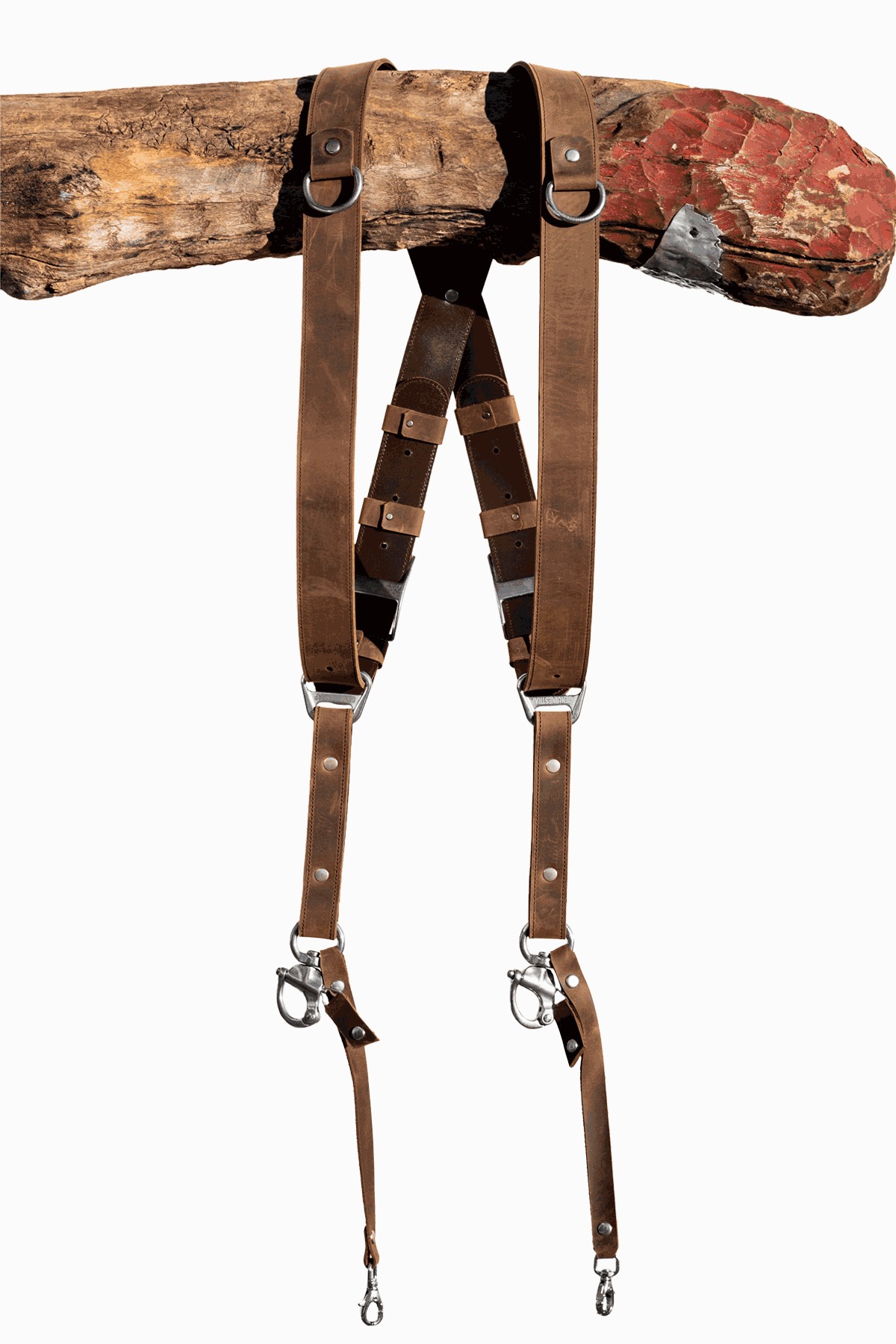
Buy nowMore coloursItalian full grain leather, sliders, safety locks and 2 camera screws included. Pick your colour.
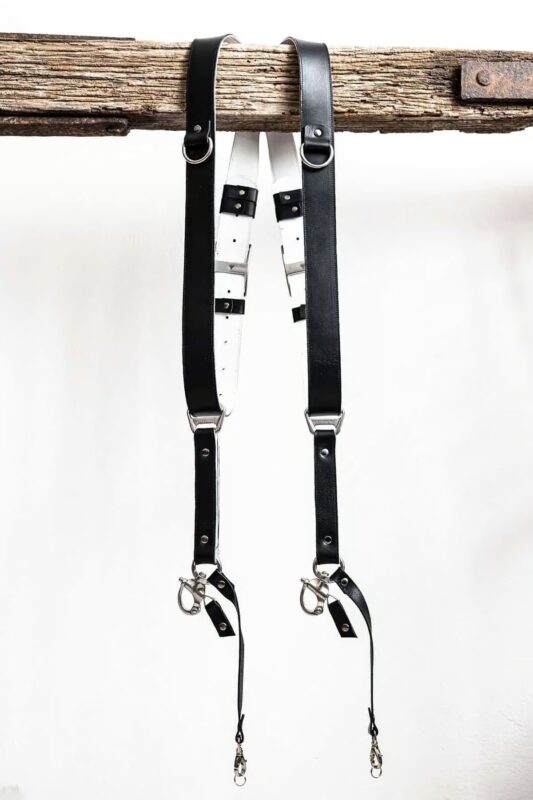
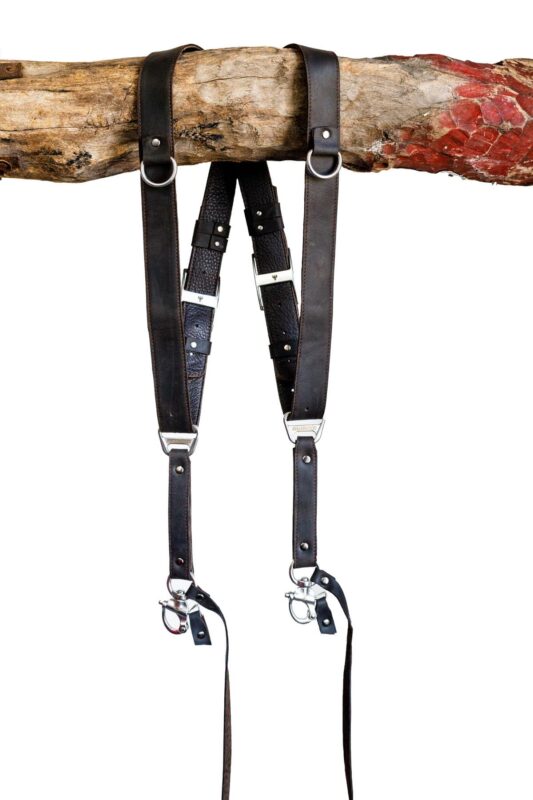
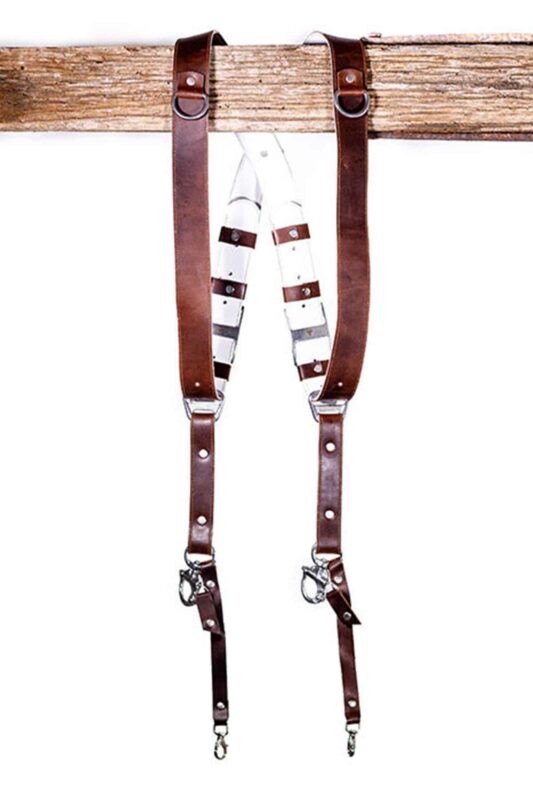
Brown Vintage Leather Camera Harness190.00 €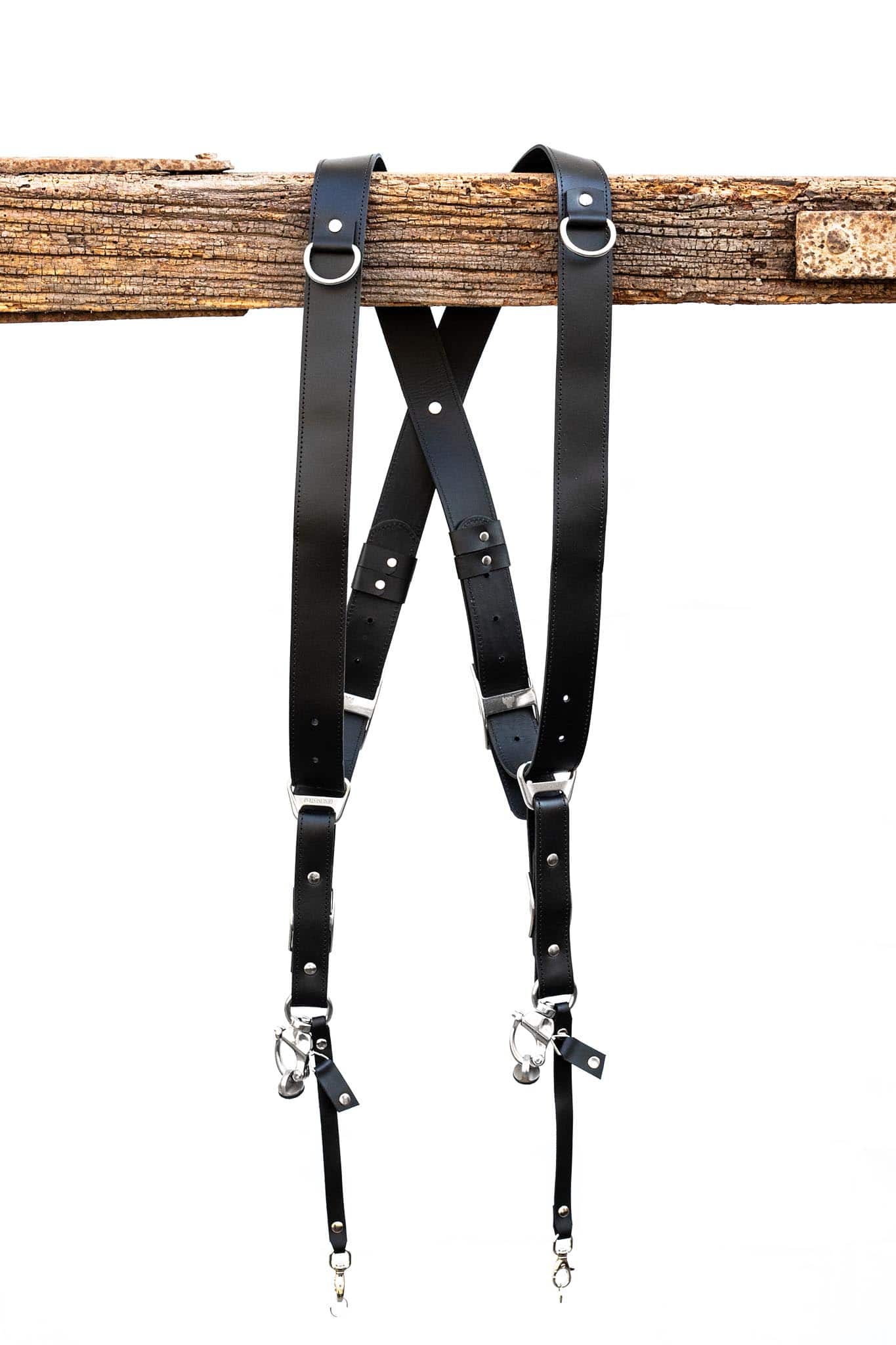 Black Cruzan Leather Camera Harness190.00 €
 Black Vintage Leather Camera Harness190.00 €
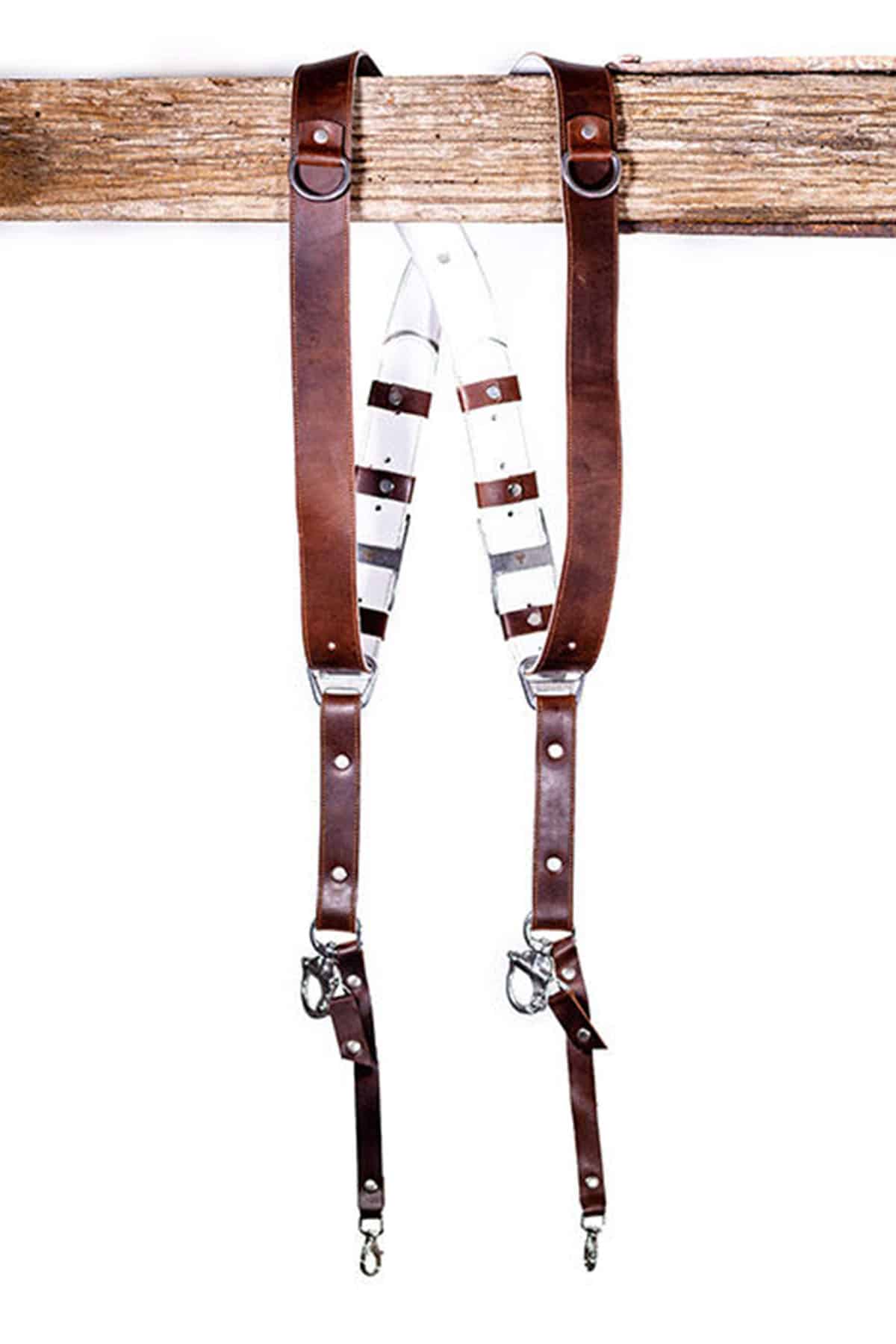 Brown Vintage White Padding Leather Camera Harness190.00 €
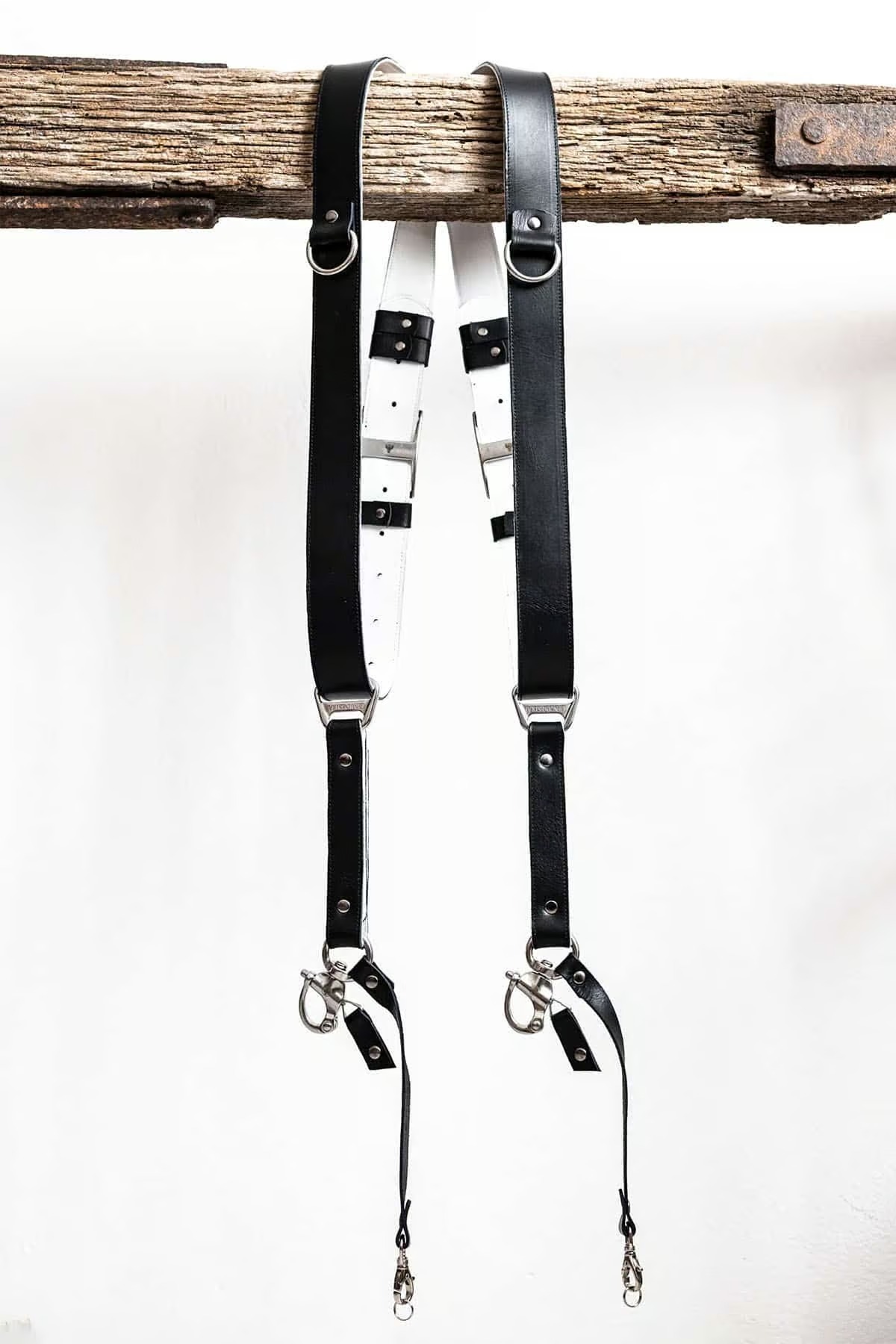 Black & White SW Leather Camera Harness190.00 €
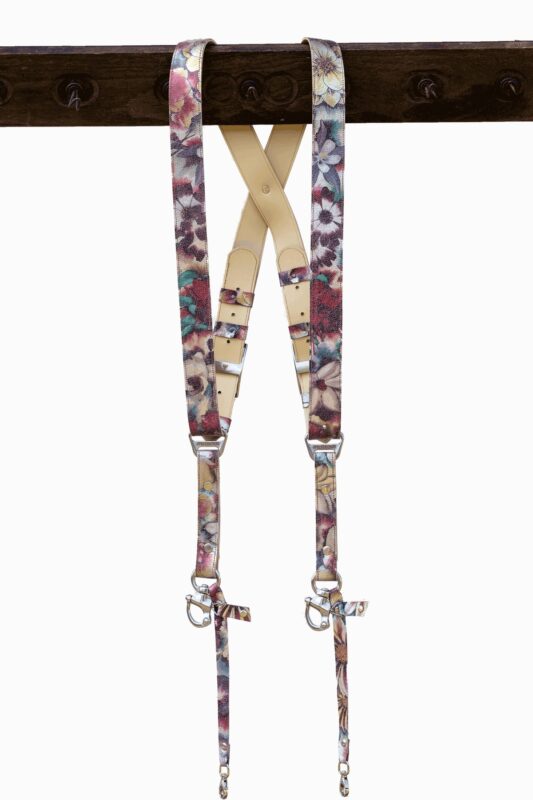
 Grey Goose Vintage Camera Harness190.00 €
 Dark Brown Garioch Leather Camera Harness190.00 €
 Brown Siena Camera Harness190.00 €
Swipe to see every colour →
Hardly anyone keeps the same pair from nine in the morning to midnight. Space and light change, and so do the lenses. These are the patterns photographers describe most often, with primes and with zooms.
| Moment | With primes | With zooms |
|---|---|---|
| Getting ready | 24 + 50 | 24-70 + 105 macro |
| Ceremony | 35 + 85 | 24-70 + 70-200 |
| Reception | 35 + 85 | 24-70 + 85 f/1.4 |
Zooms (24-70 and 70-200) cover everything but weigh more. Primes (35 and 85) are light and bright but make you move more. Many switch depending on the moment of the day.
There is no correct side. Many keep the telephoto on the right and the wide on the left, others the opposite. What matters is never changing it, so your hand finds the camera without looking.
Yes. If the lens has a tripod collar, fit the 1/4″ screw there so the weight does not hang on the mount. Every harness comes with 2 camera screws.
With the third camera extenders, which clip onto the D-rings. When you order the harness, choose the option with D-rings.
Two bodies, two different lenses, always on the same side. Wide in the morning, longer for the ceremony, fast glass in the evening. The heavy telephoto hangs from its collar. Habit does the rest.
Italian full grain leather, V3 stainless steel hardware, made to your height, optional engraving.
No account yet?
Create an Account












 Camera Straps Double
 Camera Straps Single
 Camera Straps Neck
 Camera Straps Wrist
 Other Camera Accessories
 Home Decor
 Mouse Pads
 MacBook Sleeves
 Desk Mats
 Bottle Lamps
 Edison Lamps
 Aprons
 Belts
 Bow Ties
 Keychains
 Wedding & Formal
 Camera Bags
 Backpacks
 Belt Pouches
 Handbags
 Wallets & Cases
 Engraved Items
 Gift Sets
 Gifts for Her
 Gifts for Him
 Notebooks & Journals
 USB Stick
 Engraved Panoply
 Engraved Icons